
From Dashboards to Decisions: How Marketing Teams Can Measure What Really Matters
1.20.26 | Diana Berry
For years, paid media measurement has followed a familiar rhythm.
Track impressions, reach, CPMs, clicks, CTR, CPC, and conversions
Build dashboards
Optimize toward efficiency
Report on performance
For many organizations, this work represents a meaningful investment of time and resources. Budgets are tight there’s very little room for wasted spend. These metrics are accessible, familiar and immediately actionable. This makes them useful for optimization, telling us what happened, not always why it happened or what truly caused it. As marketing ecosystems become more complex and privacy changes reduce visibility, understanding contribution and causality becomes more important. That doesn’t mean every team needs advanced marketing mix modeling tomorrow. But it does mean teams benefit from understanding what these methods are, what questions they answer, and when they become worth considering. In this article, we will breakdown 5 measurement models, so that we can better understand their best use cases and how we can start to move toward more meaningful measurement in the future, while being realistic about what we can measure now.
The Measurement Landscape, Simplified
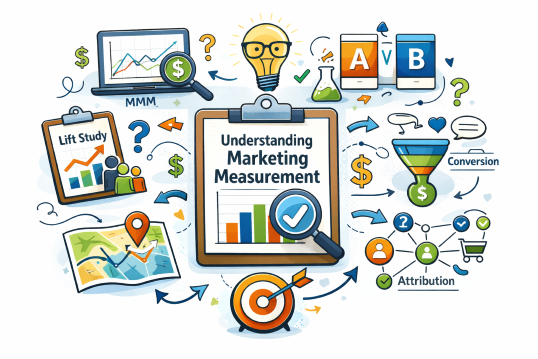
The 5 measurement models we will cover include: Marketing Mix Modeling (MMM), Conversion Lift, A/B Testing, Incrementality Testing, and Attribution (last click, muti-touch). Below are high-level overviews of each method.
1. Marketing Mix Modeling (MMM) helps identify the long-term contribution of each channel to guide budget allocation.
What it helps answer
How different marketing channels contribute to overall business outcomes over time, not just in the moment, but across months or years.When it makes sense
MMM becomes valuable when a brand is thinking beyond campaign-level performance and asking strategic questions about budget allocation. It’s often used when marketing investments are large enough that small percentage improvements can have meaningful impact.Data required
Aggregated historical data across channels, typically covering long time periods. This approach looks at trends, not individuals.Strengths
Provides a holistic, privacy-safe view of performance and captures the impact of upper-funnel and offline efforts that don’t show up well in platform reporting.Trade-offs
Insights take time to produce and aren’t designed for day-to-day optimization. It doesn’t explain which creative or audience performed best.Further Reading: Marketing Mix Modeling Explained for Better Budget Planning (funnel.io)
2. Conversion Lift measures the incremental effect of a marketing campaign on the desired action (conversion), above and beyond what would have happened naturally.
What it helps answer
Did this campaign drive conversions or would those outcomes have happened anyway?
When it makes sense
Conversion lift is especially useful when teams want to validate a major campaign, test a new channel, or justify spend to stakeholders. It’s often used selectively rather than continuously.
Data required
Clearly defined conversion events and the ability to compare an exposed group to a similar unexposed group.
Strengths
Direct, causal, and highly credible. It isolates true impact instead of relying on correlation.
Trade-offs
Requires planning and sufficient scale. Not always practical for very small campaigns or limited budgets.
Time frame
Short- to mid-term (weeks to months).
Further Reading: What is Conversion Lift Rate? (cometly)
3. A/B Testing is a marketing method to compare two or more versions of a marketing element to see which performs better.
What it helps answer
Which version of an ad, message, or experience performs better?When it makes sense
A/B testing is often the most accessible next step for teams looking to evolve their measurement. It’s ideal for creative, messaging, landing pages, and user experience improvements.Data required
Enough traffic or volume to reach statistical significance.Strengths
Fast, low-risk, and highly actionable. Small changes can lead to meaningful gains over time.Trade-offs
Focused on narrow elements rather than holistic performance. It doesn’t explain cross-channel or long-term impact.Time frame
Short-term (days to weeks).Further Reading: A/B Testing-What It Is, examples and Best Practices (Adobe)
4. Incrementality Testing is the “true” impact metric in marketing measurement, showing what actions, conversions, or sales happened because of your marketing beyond what would have occurred naturally.
What it helps answer
What outcomes happened because of marketing efforts not just alongside them?When it makes sense
Incrementality testing becomes valuable when multiple channels are working together and teams want to understand true contribution, halo effects, or whether certain tactics are over-credited.Data required
The ability to establish control conditions through audience splits, geographic tests, or time-based comparisons.Strengths
Provides a clearer picture of causal impact across channels and helps prevent over-attribution to lower-funnel activity.Trade-offs
More complex to design and analyze. Not always feasible for low-volume campaigns.Time frame
Mid-term (weeks to months).Further Reading: What is Incrementality Testing (funnel.io)
5. Attribution is the practice of assigning the credit for a conversion or desirable outcome to the marketing activities preceding the action. Different attribution models can be simple (first touch or last touch) or advanced (multi-touch or algorithmic).
What it helps answer
How different touchpoints contributed to a conversion along the customer journey.When it makes sense
Attribution is often the backbone of everyday reporting and optimization, especially for teams managing active campaigns across multiple channels.Data required
Consistent tracking and clearly defined conversion paths.Strengths
Timely, familiar, and easy to act on. Helps teams make informed tactical decisions.Trade-offs
Often over-weights lower-funnel channels and can miss true causality, especially in privacy-constrained environments.Time frame
Short-term (real-time to monthly).Further Reading: Marketing Attribution Explained (Adobe)
The Takeaway
Measurement evolution is a ladder, not a leap. Teams should measure the right thing at the right time. Measurement builds confidence, protects budgets, and guides smarter decisions. Understanding what’s possible today prepares teams to act when opportunities arise. Even small steps like introducing A/B Testing, extending attribution thinking beyond last-touch, or running a brand or lift study around a major initiative can unlock valuable insights. The goal today isn’t to do everything. It’s to understand what exists, what’s missing, and what questions you should be asking next.